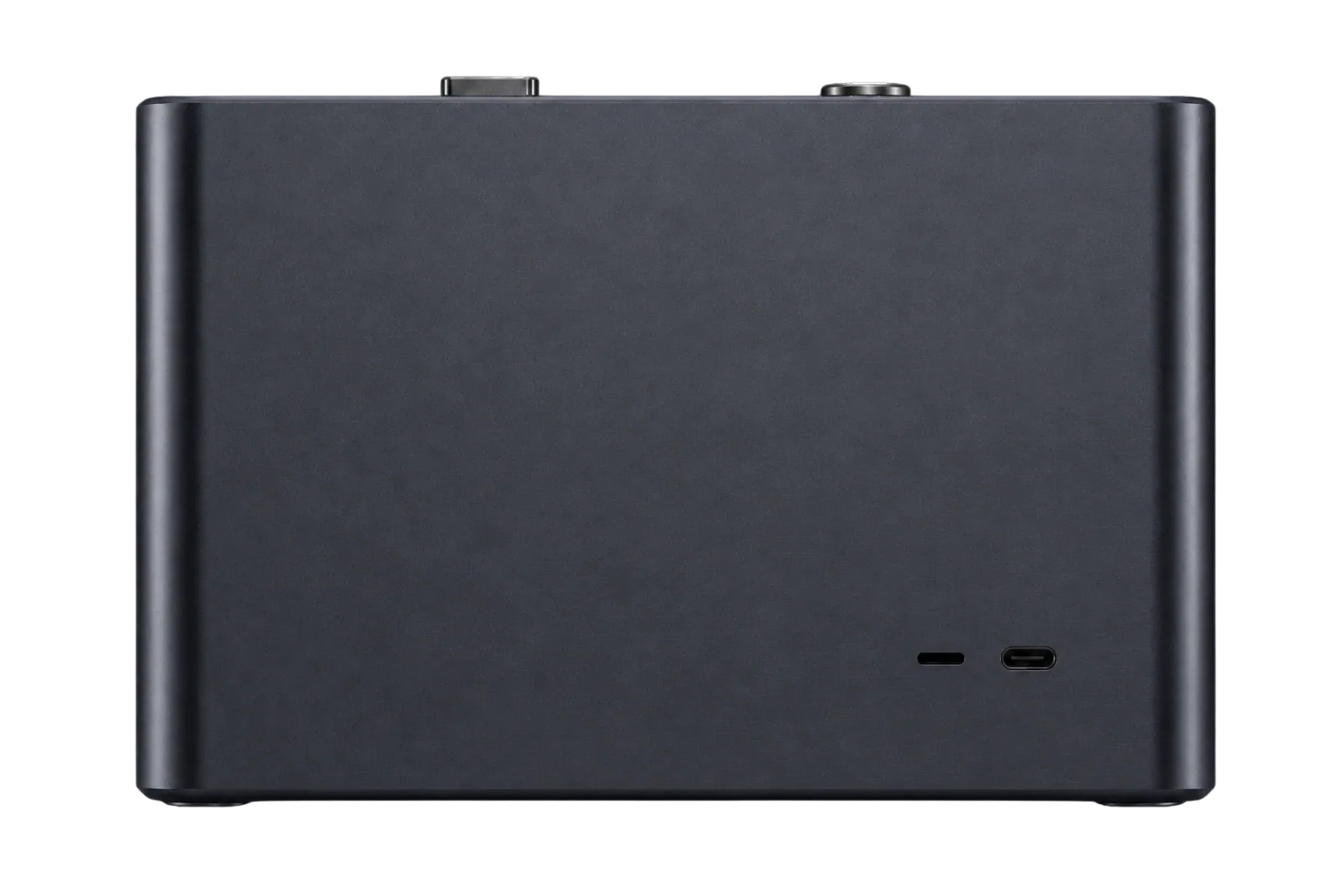
76TOPS
Neural Engine
128GB
Unified Memory
4TB
NVMe Storage
5"
Touch Console
TB5
Thunderbolt 5
MagSafe
Charging
Overview
The most capable on-device AI ever built.
Octaven Pro is designed for production workloads, enterprise deployments, and anyone who needs to run serious AI without ever sending a single token to the cloud. With 128 GB of unified memory and a 4 TB NVMe SSD, it can hold the largest open-source models in existence entirely in RAM — no quantization tricks, no offloading, no compromises. Every inference runs locally, every result stays on your premises, and every computation is bounded by hardware you own.
What sets Octaven Pro apart is its dual-architecture inference pipeline. A 38 TOPS neural engine handles transformer-class inference, while a dedicated inference accelerator tackles the matrix-heavy operations of large-batch inference, RAG, and real-time agent orchestration. The two units communicate through a high-bandwidth on-chip interconnect, dynamically distributing workload to deliver throughput that rivals cloud GPU instances — with latency that cloud can never match because there is no network in the loop.
Two engines. One purpose.
Octaven Pro combines a 38 TOPS neural engine with a dedicated inference accelerator — two purpose-built silicon blocks designed from the ground up for different computational profiles. The neural engine excels at sequential token generation and multi-turn conversation, while the accelerator dominates at parallel matrix operations, embedding lookups, and batched inference. Together, they deliver 76 TOPS of combined AI throughput, dynamically routing each request to the optimal compute unit in real time.
The result is a device that handles concurrent agent orchestration, real-time RAG pipelines, and long-form content generation with a fluidity that feels less like waiting for a computer and more like collaborating with a colleague. Because there is no network round-trip, latency is measured in single-digit milliseconds — not the hundreds of milliseconds you tolerate with cloud APIs. For teams running production AI, this is not an incremental improvement. It is a fundamentally different way to work.
Enterprise AI. On your desk.
Octaven Pro serves as a local inference endpoint for development teams, running multiple model instances simultaneously without contention. Its 128 GB of unified memory means that even 70-billion-parameter models can be loaded at full precision, preserving every nuance of the original weights. The 4 TB SSD provides room for dozens of model variants, embeddings databases, and vector stores — everything you need to build, test, and deploy AI-powered applications without ever touching a cloud console.
Whether you are building internal tools, customer-facing applications, or research prototypes, Octaven Pro gives you the compute you need without the operational overhead of cloud GPU management. No provisioning wait times, no surprise billing spikes, no capacity planning meetings. You buy the hardware once, and the capability is yours — predictable, bounded, and entirely under your control. For enterprises navigating compliance requirements around data residency, PII handling, and auditability, Octaven Pro meets those requirements by architecture, not by policy documents.
Certainty the cloud can't provide.
Security is foundational to Octaven Pro, not an afterthought. A hardware-backed Secure Enclave manages encryption keys in isolated silicon, ensuring that model weights, user data, and conversation history remain encrypted at rest and in transit — even if the physical device is compromised. All storage is encrypted by default, and the encrypted volume is tied to the Secure Enclave, so removing the SSD yields nothing usable.
For organizations that require it, Octaven Pro supports managed device enrollment, remote configuration, and comprehensive audit logging — all without phoning home to a central server. A physical hardware privacy switch disconnects all sensors at the circuit level, providing an air-gapped mode that no software override can bypass. In a world where data breaches make daily headlines, Octaven Pro offers a fundamentally different path: keep the AI close, keep the data closer, and keep the cloud out of the equation entirely.